Here’s a simple line chart:
It’s intuitive to most of us that means growth, means decline, and means no change. Also, the more the line rises or falls at each step, the steeper it gets.
There’s a number that can tell us how steep a line is and which way it goes. This number is called slope.
For example:
To calculate slope, you can take any two points on and divide the vertical change by the horizontal change :
Note. If you make a perfectly vertical line , you’ll see that we can’t calculate the slope. Is it the steepest rise or the steepest fall? Is it growth or decline? We can’t really tell. That’s why such a slope is undefined.
You can also think of slope as the change per unit: how much the line rises or falls for one step to the right.
Take a look at where meets . The vertical position of is the slope:
Slope is often used in everyday life. For example, wheelchair ramps should be no steeper than 1:12 . That’s one step up for every twelve across, a slope of about 0.08.
This road sign also indicates slope, but as a percentage:
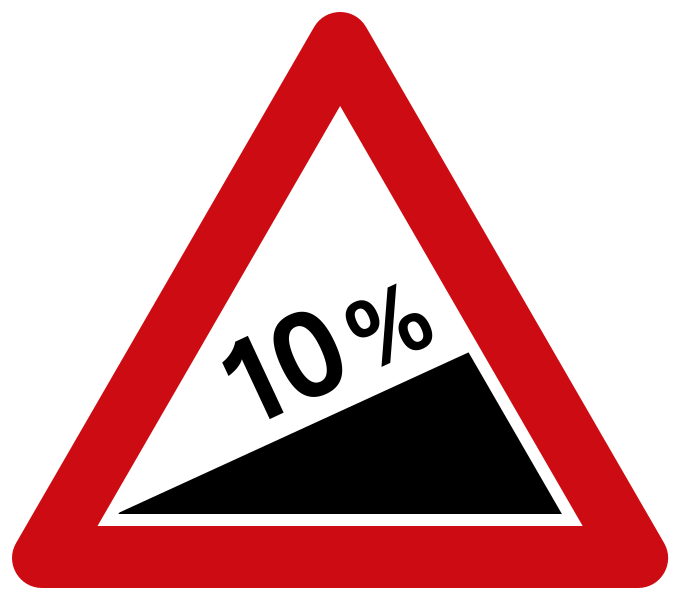
(a slope of 0.1)
Sometimes we know only an angle, not the sides. A typical escalator, for example, rises at 30° . How steep is that, as a slope?
This is where tangent comes in: give it an angle and it gives you the slope. For 30°, that’s about 0.58.
Let’s see how it works for angles up to 360°.
The line touches the circle at just one point. It’s called a tangent line. Tangens is Latin for “touching.”
Our tangent lies on this line.
That’s where it gets its name.
If we zoom in a little, we’ll see the unit circle that we know from the first chapter.
The vertical change is sine and the horizontal one is cosine . Divide sine by cosine and you get the tangent .
Tangent converts an angle into a slope.
It shows how far you go up or down if you take just one step across.
Knowing this, you can imagine or sketch any line. Got a slope of 3? One right, three up, and you have it.
Thanks for reading!
To be continued: Radians, and why they replace degrees with all those π and 2π things.